Company-management platform with an AI copilot
Shareholder registry, general meetings and intelligent search across cantonal tax sources, with one requirement that shaped everything: zero hallucination on Swiss tax law.
Context
Tax law firms and fiduciaries spend a considerable share of their time on two tasks: administering the legal life of their clients' companies, and finding the applicable rule across twenty-six cantonal tax corpora that do not say the same thing.
The first problem is a management-software problem. The second looks like an AI use case, provided you accept one requirement that most demonstrations quietly avoid.
Constraints
A wrong answer in tax law does not cost a poor user experience, it costs a reassessment. The system therefore had to be able to answer 'I do not know' rather than produce something plausible, and to cite its source for every statement.
Professional secrecy came on top of that. The files handled contain data that nobody agrees to send to an American programming interface, whatever terms the vendor publishes.
Solution
A web platform covering the management side: shareholder registry, convening and running general meetings, tracking company portfolios, end to end.
On top of it, a research copilot backed by the cantonal tax sources. Every answer points to the text it comes from, with its reference, and the user can open it. An answer with no source is not shown.
Architecture
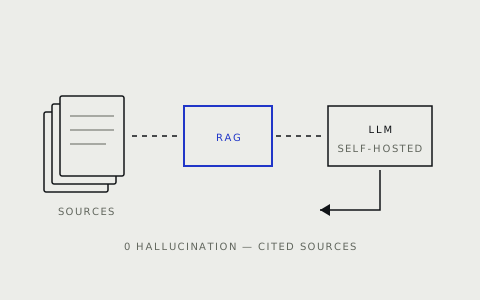
The copilot rests on a retrieval-augmented generation architecture. The tax corpora are chunked, indexed and queried at question time; the model works only on the extracts handed to it, not on what it memorised during training. That constraint is exactly what makes citation possible and hallucination difficult.
The sequence of retrieval, filtering and drafting steps is orchestrated with LangGraph, which makes the reasoning traceable step by step rather than something to be endured. The whole system runs on sovereign infrastructure: the files never leave the perimeter the client controls.
Sizing came from a business evaluation set built with the lawyers: real questions, expected answers, and an explicit acceptance criterion on the proportion of unsourced answers.
Outcome
The platform is in service and covers the full company-management cycle. The copilot answers with its sources, and stays silent when the corpus does not support a conclusion, which was the objective.
The architecture transfers: the same pattern applies to any regulated document corpus where an unverifiable answer is unusable.
Web · RAG · LangGraph · Self-hosted LLM · Sovereignty