Virtual eyewear try-on in augmented reality
Letting customers see a frame on their own face, at the right size, from their iPhone, and giving them a reliable pupillary-distance measurement along the way.
Context
Buying glasses online always runs into the same question: what will this frame look like on my face? Without a convincing answer, customers hesitate, abandon their basket, or order several models only to send most of them back.
Our client, a leading optics-technology provider, supplies virtual try-on to opticians and online retailers. They asked us to build the iOS experience, for a large catalogue of frames renewed with every collection.
Constraints
Realism first. A frame that floats in front of the face, slips when the head turns or is the wrong scale does more harm than no try-on at all: it destroys trust at the very moment you are trying to build it.
Measurement next. Pupillary distance is used to manufacture the lenses: it is not enough for it to look plausible, it must be accurate enough to use when ordering.
Smoothness last: the try-on has to run smoothly across several generations of iPhone, not just the latest model.
Solution
An iOS try-on module built into the purchase journey: the front camera opens, the frame settles on the face and follows it in real time. Customers switch model or colour without leaving the try-on.
In the same gesture, the app measures pupillary distance and offers it at checkout, removing a step many customers cannot do on their own.
Architecture
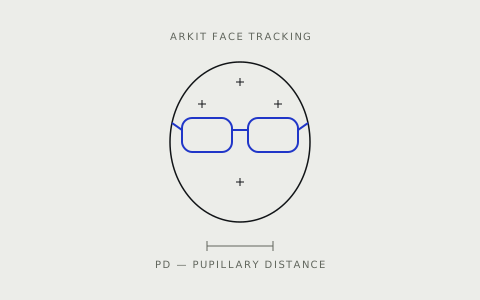
Face tracking relies on ARKit and the TrueDepth camera: on every frame, the app has a face mesh and the head pose. The 3D frame is anchored to that mesh, at real scale, and the face correctly hides the temples as the head turns.
Pupillary-distance measurement uses the eye positions provided by face tracking, stabilised over several frames to smooth out micro-movements. Real-time rendering takes care of the materials that matter in eyewear: acetate, metal and lens reflections.
Face tracking is computed on the device.
Outcome
The try-on is built into the purchase journey: customers see the frame on their own face, at the right scale, and leave with a pupillary-distance measurement they can use for their order. That is what removes the hesitation at the moment of choosing.
The same foundation serves any sale where customers need to picture an object worn on the face: measurement and rendering matter as much as the visual effect.
ARKit · Face tracking · iOS · Real-time 3D